RAGHAV AI and Suryast: When Human Creativity Meets Artificial Intelligence
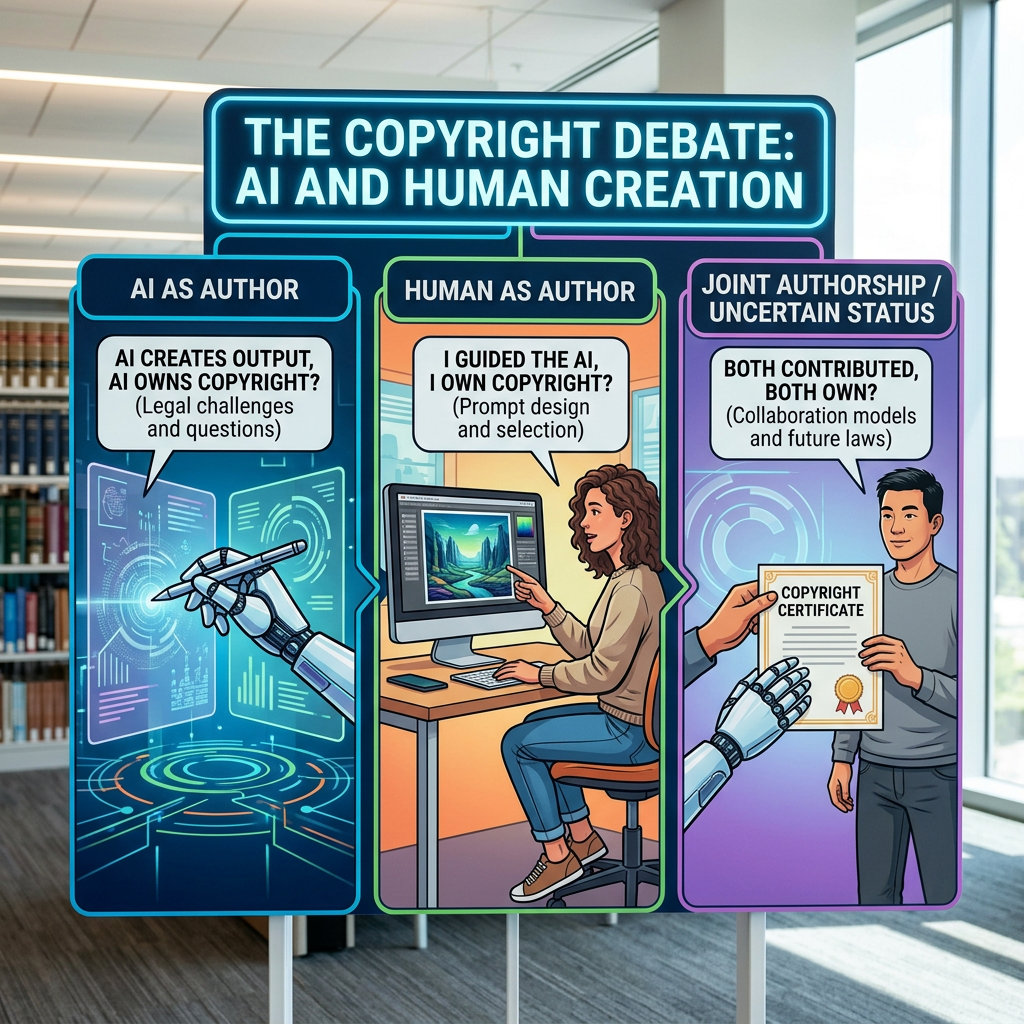
The shift from traditional machine learning to generative AI models has turned the age-old question of “Who created it?” into an intriguing legal puzzle, particularly in the realm of intellectual property, throwing a new curveball at copyright law. At its very core, copyright seeks to protect the creativity, hard work, and sweat and blood that goes into bringing an idea to life. But what happens when a simple prompt fed into an AI model generates a work that would otherwise require considerable human creativity and effort?
This dilemma brings the traditional “sweat of the brow” doctrine into focus, challenging us to think about the relationship between human creativity, innovation, and the legal protection afforded to creative works.
The Sweat of the Brow: A Doctrine in Evolution
The “sweat of the brow” doctrine emerged from the principle that the labour, skill, time, and effort invested in creating a work deserve legal recognition. Historically, this approach placed considerable emphasis on the work undertaken by an author, suggesting that a person’s industrious efforts could justify copyright protection even where the resulting work involved limited creativity.
An early judicial expression of this principle can be found in Walter v. Lane [1900] AC 539[1], in which the House of Lords recognised copyright in newspaper reporters’ verbatim accounts of speeches. The decision acknowledged the skill and effort involved in accurately recording and reproducing another person’s spoken words. Subsequently, in University of London Press Ltd. v. University Tutorial Press Ltd. [1916] 2 Ch 601[2]The court clarified that originality does not require novelty; rather, a work must originate from its author and not merely be copied from another source.
Over time, however, courts increasingly recognised that labour and effort, although important, cannot be considered in isolation from the originality of the resulting work. In Feist Publications, Inc. v. Rural Telephone Service Co., 499 U.S. 340 (1991)[3], the United States Supreme Court rejected the proposition that industrious collection of information, by itself, could justify copyright protection. The Court required at least a minimal degree of creativity, holding that effort alone was insufficient.
A significant development in India came through Eastern Book Company v. D.B. Modak, (2008) 1 SCC 1. While considering copyright in edited law reports, the Supreme Court rejected a purely labour-based approach and adopted a standard requiring the exercise of skill and judgment accompanied by a minimal degree of creativity. The Court emphasised that a work must involve more than a mechanical or trivial exercise.
This approach does not diminish the importance of labour. Instead, it recognises that labour, skill, and effort contribute to copyrightable authorship when they are applied through independent judgment and result in sufficiently original expression. The law does not require every work to be novel or extraordinary, but neither does it grant copyright merely because its creation was time-consuming or difficult.
The arrival of generative AI brings this principle into sharper focus. When a person selects inputs, formulates prompts, adjusts parameters, evaluates outputs, and refines a final image or text, these activities involve substantial effort and creative judgment. Yet, the fundamental question remains unanswered, what threshold of human creative involvement should be required for copyright protection, and how should the extent of that contribution be assessed in determining whether it is sufficiently reflected in the original expression of the resulting work?
THE FIRST AI GENERATED WORK
The debate surrounding AI authorship came into focus with Suryast, an artwork created by Ankit Sahni using RAGHAV, an AI-powered painting application. Sahni provided an original photograph as the content input and Vincent van Gogh’s The Starry Night as the style reference, which the AI used to generate the final artwork.
In November 2020, the Indian Copyright Office initially registered Suryast with Sahni and RAGHAV named as co-authors. However, the Office subsequently questioned the registration, leaving the issue of AI authorship unresolved. Section 2(d)(vi) of the Copyright Act, 1957, defines the author of a computer-generated artistic work as “the person who causes the work to be created.” Yet, its application to modern AI systems raises questions about the degree of human creative involvement required for authorship.
In contrast, on 11 December 2023, the United States Copyright Office Review Board upheld the refusal to register Suryast, concluding that the final work lacked sufficient human authorship because its expressive elements were generated by RAGHAV. The decision did not exclude all AI-assisted works from copyright protection; rather, it highlighted the need to identify the human contribution to the work’s original expression.
Rethinking Copyright for AI-Assisted Creativity
Copyright law has historically developed in response to changes in how creative works are produced and disseminated. Generative AI presents another such evolution in the landscape of creativity. The objective should not be to abandon the principles of originality and authorship, but to apply them in a way that appreciates genuine human creative skills without granting exclusive rights over expression produced autonomously by a machine.
Primarily the vision should be clear between AI assisted and AI generated works. Rather than treating every use of AI in the same manner, the assessment should consider the human’s role in shaping the final expression. The use of an AI tool as an instrument does not necessarily prevent copyright protection; the question is what the human author actually contributed.
Subsequently the approach towards solving such curveballs should lead us to distinguish between the protection of an entire output and the protection of identifiable as human-authored elements within it. Where an AI-generated image incorporates an original photograph, for example, copyright may subsist in the photograph independently of whether the AI-generated transformation qualifies for separate protection. Similarly, a human’s sufficiently original editing or arrangement may be protectable even if other portions of the work are not.
There should be greater clarity regarding the ownership and allocation of rights in AI-assisted works. There is a high requirement of transparent standards for identifying human contributions, disclosing material AI involvement where required, and determining when the person directing an AI system has contributed enough original expression to qualify as an author. Such standards would support creators while preserving the public interest in preventing copyright from extending further than its legal justification.
In the age of AI, the question is no longer merely how much effort went into creating a work, rather how that effort, guided by human judgment, contributed to the original expression of the final creation.
[1] https://www.cipil.law.cam.ac.uk/virtual-museum/walter-v-lane-1900-ac-539
[2] https://www.cipil.law.cam.ac.uk/virtual-museum/university-london-press-v-university-tutorial-1916-2-ch-601
[3] https://supreme.justia.com/cases/federal/us/499/340/
-Anwesha, Associate, Ductus Legal


