Introduction:
The Environment Protection Act, 1986 is a piece of legislation that provides for the protection and maintenance of environment and related matters. India being a participant of 1972 Stockholm declaration has a duty towards the protection as well as the preservation of environment and in order to cater to the needs of a pollution free environment which is free from the havoc caused by humans, Environment Protection 1986 was enacted.
EIA (Environment Impact Assessment) Notification was introduced in 1994 and has since then undergone various amendments. The notification was revised in the year 2006, which is the current operating notification, EIA 2006. The main role of this notification is to provide green clearance to industries for which it contains various provisions on EIA methodology and process.
Features:
- Nodal Ministry: The Ministry of Environment, Forests and Climate Change (MoEFCC) notified new EIA legislation in September 2006.
- Regulatory Authority: Ministry of Environment and Forests for matters falling under Category ‘A’ in the Schedule and at State level the State Environment Impact Assessment Authority (SEIAA) for matters falling under Category ‘B’ in the said Schedule. The Appraisal Committees (Expert Appraisal Committee in case of Ministry of Environment, Forest and Climate Change and State Expert Appraisal Committee in case of State Environment Impact Assessment Authority SEIAA) evaluates the impact of the project based on the data furnished by the project authorities and make recommendations for approval or rejection of the project, which are then processed in the Ministry or SEIAA, as required, for approval or rejection.
- Prior EC is required: Certain Projects or activities shall require prior EC from regulatory authority before any construction work, or preparation of land by the project management is started on the project or activity.
Exception: For the purpose of securing the land prior EC is not required.
- Activities that require prior EC:
- All new projects or activities listed in the Schedule to this notification;
- Expansion and modernization of existing projects or activities listed in the Schedule to this notification with addition of capacity beyond the limits specified for the concerned sector, that is, projects or activities which cross the threshold limits given in the Schedule, after expansion or modernization;
- Any change in product – mix in an existing manufacturing unit included in Schedule beyond the specified range.
- Projects or Activities Covered Under the Schedule:
- Mining, extraction of natural resources and power generation (for a specified production capacity) which includes:
- Mining of minerals.
- (ii) Slurry pipelines (coal lignite and other ores) passing through national parks / sanctuaries / coral reefs, ecologically sensitive areas.
- Offshore and onshore oil and gas exploration, development & production.
- River Valley pojects
- Thermal Power Plants.
- Nuclear power projects and processing of nuclear fuel.
- Primary Processing which includes Coal washeries and Mineral beneficiation.
- Material Production which includes Metallurgical industries (ferrous &non-ferrous) and Cement Plants.
- Materials Processing which includes Petroleum refining industry, Coke oven plants, Asbestos milling and asbestos based products, Chlor-alkali industry, Soda ash Industry and Leather/skin/hide processing industry.
- Manufacturing / Fabrication which includes:
- Chemical Fertilizers
- Pesticides industry and pesticide specific intermediates (excluding formulations)
- Petro-chemical complexes (industries based on processing of petroleum fractions & natural gas and/or reforming to aromatics).
- Manmade fibers manufacturing
- Petrochemical based processing (processes other than cracking & reformation and not covered under the complexes).
- Synthetic organic chemicals industry (dyes & dye intermediates; bulk drugs and intermediates excluding drug formulations; synthetic rubbers; basic organic chemicals, other synthetic organic chemicals and chemical intermediates).
- Distilleries
- Pulp & paper industry excluding manufacturing of paper from waste paper and manufacture of paper from ready pulp without bleaching.
- Sugar Industry.
- Service Sectors which includes:
- Oil & gas transportation pipe line (crude and refinery/ petrochemical products), passing through national parks / sanctuaries /coral reefs / ecologically sensitive areas including LNG Termina.
- Isolated storage & handling of hazardous chemicals (As per threshold planning quantity indicated in column 3 of schedule 2 & 3 of MSIHC Rules 1989 amended 2000).
- Physical Infrastructure including Environmental Services which includes:
- Airports
- All ship breaking yards including ship breaking units.
- Industrial estates/ parks/ complexes/ areas, export processing Zones (EPZs), Special Economic Zones (SEZs), Biotech Parks, Leather Complexes.
- Common hazardous waste treatment, storage and disposal facilities (TSDFs).
- V “Ports, harbours, break waters, dredging.”
- Highways
- Aerial ropeways
- Common Effluent Treatment Plants (CETPs).
- Common Municipal Solid Waste Management Facility (CMSWMF).
- Building /Construction projects/Area Development projects and Townships which includes Building and Construction projects; and Townships and Area Development projects.
Note: The Schedule which lists the aforesaid projects/ activities, for the purpose of granting Environment clearances bifurcates the projects/Activities into Category A and Category B. For Category A project the EC is granted by Ministry of Environment, Forest and Climate Change. For Category B projects the EC is granted by State Environment Impact Assessment Authority (SEIAA). Further for the purpose of obtaining EC, projects/activities are subjected to certain general conditions and Specific Conditions mentioned in the schedule.
- General Conditions for prior EC: The EIA 2006 notification states that Projects falling under Category B will be treated as Category A, if located in whole or in part within 10 km from the boundary of:
- Protected Areas notified under the Wild Life (Protection) Act, 1972.
- Critically Polluted areas as identified by the Central Pollution Control Board.
- Eco-sensitive areas.
- Inter-State boundaries and International boundaries: In case of Inter-State boundaries and International boundaries, the states or Union Territories sharing a common boundary can do away the requirement regarding distance of 10 km by an agreement between the respective States or Union Territories, subject to the condition that the activity does not fall within 10 kilometres of Protected Areas, Critically Polluted areas and Eco-sensitive areas.
- Specific Conditions for Prior EC:
If any Industrial Estate/Complex / Export processing Zones /Special Economic Zones/Biotech Parks / Leather Complex with homogeneous type of industries or those Industrial estates with pre –defined set of activities (not necessarily homogeneous, obtains prior environmental clearance, individual industries including proposed industrial housing within such estates will not be required to take prior environmental clearance, so long as the Terms and Conditions for the industrial estate/complex are complied with.
Such estates/complexes must have a clearly identified management with the legal responsibility of ensuring adherence to the Terms and Conditions of prior environmental clearance, who may be held responsible for violation of the same throughout the life of the complex/estate.
- Application for Obtaining prior EC:
- Application to be filled and submitted in ‘PARIVESH’ Portal.
- In order to apply for prior EC, an application shall be submitted in Form 1 along with a copy of the pre-feasibility project report.
- In case of construction projects listed under item 8 of the Schedule, Supplementary Form 1A is to be filled along with Form 1 followed by submission of a copy of the conceptual plan. For the purpose of submitting Supplementary Form 1A, Item 8 of the Schedule includes Building /Construction projects/Area Development projects and Townships Project.
- Application for prior EC process for Expansion or Modernization or Change of product mix in existing projects shall be made in Form I. The application shall be considered by the concerned Expert Appraisal Committee or State Level Expert Appraisal Committee within sixty days, who will decide on the due diligence necessary including preparation of EIA and public consultations and the application shall be appraised accordingly for grant of environmental clearance.
- Stages in Prior Environmental Clearance (EC) Process for new projects:
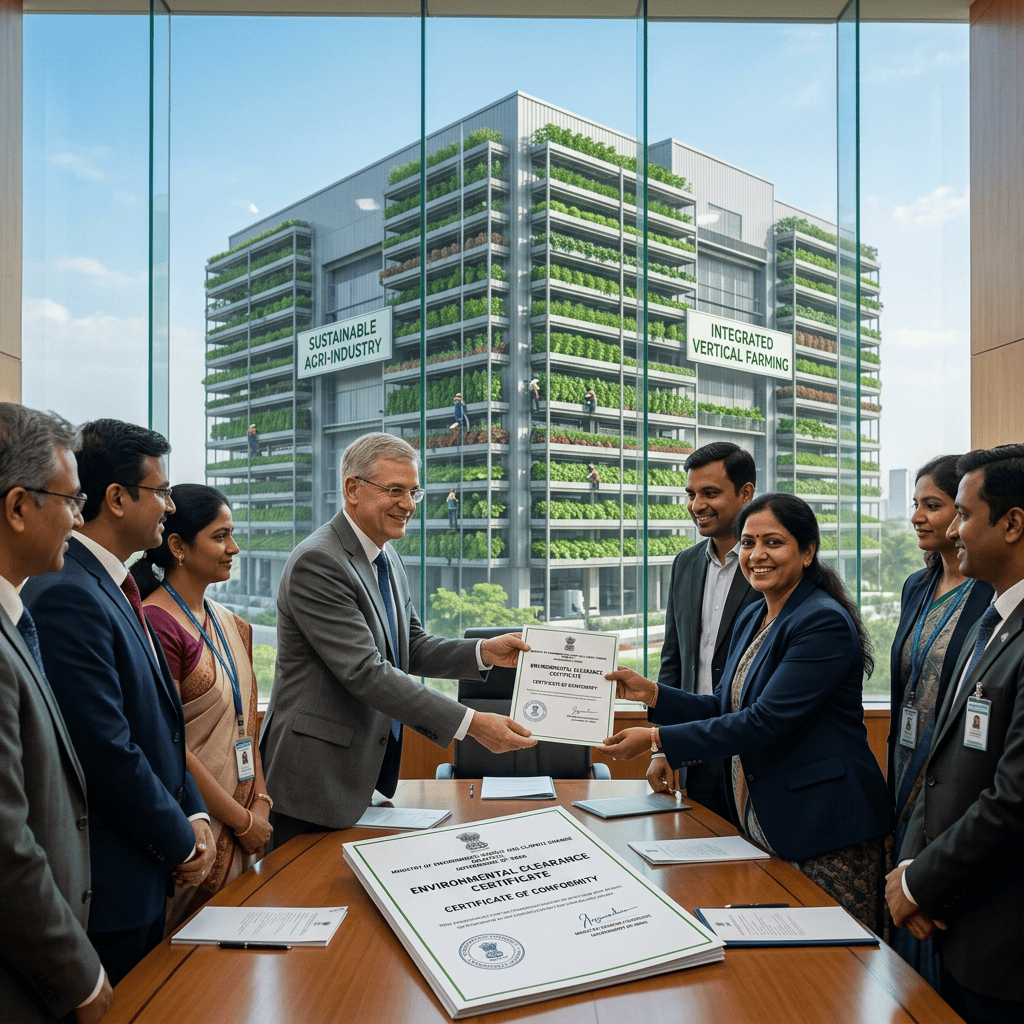
The environmental clearance process for new projects will comprise of a maximum of four stages in the order of Screening, Scoping, Public Consultation and Appraisal. It is not necessary that all projects must undergo all four stages. For instance, the screening process applies only to Category B projects and activities. The project is initially assessed for the need of an environmental impact assessment and concludes with a detailed evaluation done by an expert committee of the EIA report. The expert committee then provides recommendations to the regulatory authority on whether to grant or deny environmental clearance. Once the EC is granted, the project proponent must comply with the conditions set out in the environmental clearance certificate.
NOTE: In cases which are site specific, a two stage clearance procedure has been adopted, whereby the project authorities have to obtain site clearance before applying for environmental clearance of their projects.
Conclusion:
Once application for EC is submitted, the project authorities can track the proposal for EC via ‘Parivesh Portal’ wherein the Home page of the portal provides an icon stating ‘ Track your Proposal’. By clicking on that icon you are asked to provide either Proposal Number or Single Window Number or Proposal Name. On providing either one can track their proposal.
*For the purpose of this article:
i. EC means Environmental Clearance.
ii. EIA means Environment Impact Assessment.
iii. SEIAA means State Environment Impact Assessment Authority.
iv. MOEFCC means Ministry of Environment, Forest and Climate Change.
–By Sakshi Khulve, Principal Associate, Ductus Legal


