Introduction
Industrial development plays a significant role in economic growth, employment generation and infrastructure development. However, the establishment of industrial units may also result in air and water pollution, generation of hazardous waste and depletion of natural resources. To address these environmental concerns, India has developed a regulatory framework requiring industries to obtain prior environmental approvals before commencing specified activities. One such important approval is Consent to Establish (CTE), granted by the concerned State Pollution Control Board (SPCB) or Pollution Control Committee (PCC).
CTE is a preventive environmental compliance mechanism that enables pollution control authorities to examine the environmental implications of a proposed industrial establishment before it becomes operational. The authority assesses factors such as the proposed manufacturing process, project location, water consumption, wastewater generation, air emissions and proposed pollution-control measures. The objective is to ensure that adequate environmental safeguards are incorporated at the project-planning stage itself.
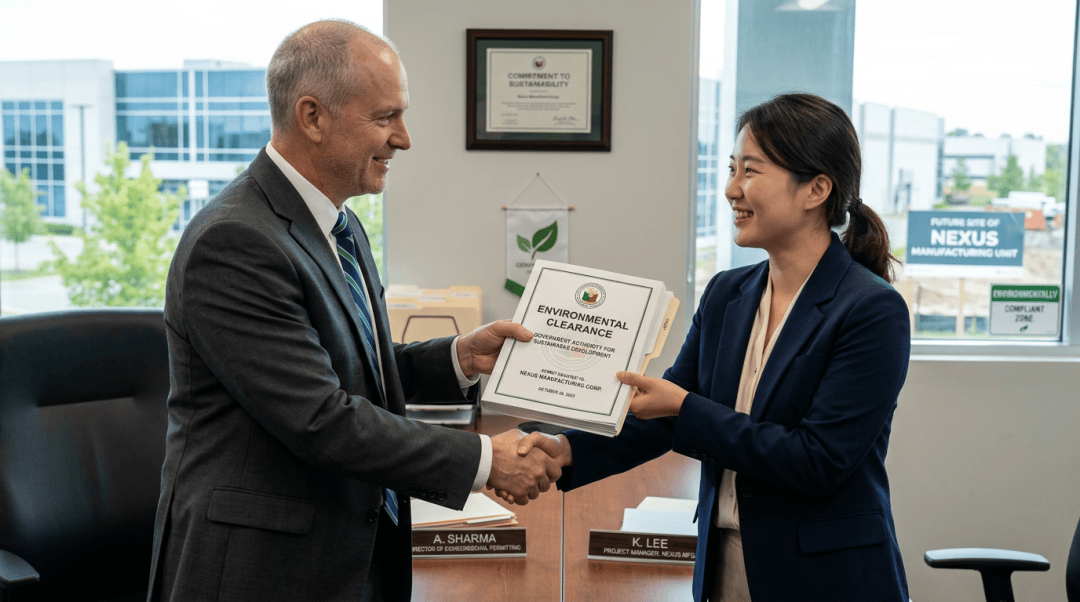
The requirement for obtaining CTE primarily arises under the Water (Prevention and Control of Pollution) Act, 1974 and the Air (Prevention and Control of Pollution) Act, 1981. It is important to distinguish CTE from Consent to Operate (CTO), which is required before commencing industrial operations, subject to the applicable regulatory framework. CTE is also distinct from Environmental Clearance (EC) under the Environment (Protection) Act, 1986 and the Environment Impact Assessment Notification, 2006. Depending upon the nature of the project, an industrial establishment may be required to obtain both EC and CTE, as these approvals serve different regulatory purposes.
Regulatory Framework Governing CTE
Water (Prevention and Control of Pollution) Act, 1974
The Water Act, 1974 provides the statutory framework for preventing and controlling water pollution and maintaining or restoring the wholesomeness of water. Section 25 is particularly relevant to CTE, as it prohibits any person from establishing or taking steps to establish an industry, operation or process, or any treatment and disposal system likely to discharge sewage or trade effluent into a stream, well, sewer or on land, without obtaining the previous consent of the State Pollution Control Board. The provision also regulates the use of new or altered outlets for sewage discharge and the commencement of new discharges. Accordingly, the concerned SPCB examines the proposed wastewater generation, treatment and disposal arrangements before granting consent.
Air (Prevention and Control of Pollution) Act, 1981
The Air Act, 1981 regulates activities that may result in air pollution and provides for the control of emissions from industrial plants. Section 21 requires prior consent of the State Pollution Control Board for establishing or operating an industrial plant in an area notified as an Air Pollution Control Area, subject to the applicable statutory provisions and exemptions. While considering a CTE application, the authority examines the proposed manufacturing process, fuel consumption, emission sources and arrangements for installing air pollution-control equipment. It may also prescribe conditions relating to emission standards, stack height and pollution-control devices to ensure compliance with applicable requirements.
Industrial Categorisation and Uniform Consent Guidelines
For regulating industries according to their pollution potential, the Central Pollution Control Board (CPCB) classifies industrial activities into Red, Orange, Green and White categories. Red-category industries generally have high pollution potential, Orange-category industries have moderate pollution potential, Green-category industries have comparatively low pollution potential, while White-category industries are considered to have negligible pollution potential and are generally exempt from regular CTE and CTO requirements, subject to applicable conditions.
Procedure for Obtaining Consent to Establish
The procedure for obtaining CTE is administered by the concerned SPCB or PCC through its prescribed online consent management system. Although the broad statutory requirements remain common, the application process, documentation, fee structure and approval authorities may differ between States and Union Territories.
- Determination of Applicability and Industry Categorisation
The first step is to determine whether the proposed industrial activity requires prior consent under the Water Act, 1974, the Air Act, 1981 or both. The project proponent must examine the nature of the manufacturing process, anticipated wastewater generation, air emissions and pollution potential of the proposed activity. The applicable industrial category must also be identified in accordance with the latest CPCB classification and relevant State-specific directions. This classification is important because it determines the level of scrutiny, applicable consent fees, documentation requirements and approval authority. The project proponent must also independently assess whether Environmental Clearance or any other statutory permission is required before establishing the project.
- Preparation of Application and Supporting Documents
Once the applicability and category have been determined, the applicant must prepare the prescribed CTE application along with the relevant supporting documents. These generally include proof of ownership or lawful possession of the proposed site, a Detailed Project Report (DPR), site and vicinity plans, plant layout, manufacturing process flow chart and details of proposed pollution-control measures. The application must also contain information concerning capital investment, production capacity, water consumption, wastewater generation, air emissions and solid and hazardous waste management. A water balance statement and details of proposed Effluent Treatment Plants (ETPs), Sewage Treatment Plants (STPs) and air pollution-control equipment may also be required, depending upon the nature of the industry. The exact documentation requirements are prescribed by the concerned SPCB or PCC and may vary according to the industrial category.
3.Submission of Online Application and Payment of Fees
The completed application and supporting documents are required to be submitted through the online consent management portal of the concerned SPCB or PCC. The applicant must furnish the prescribed particulars relating to the industrial establishment and upload the necessary technical and statutory documents. The applicable consent fee must also be paid in accordance with the prescribed fee structure, which may depend upon the investment and category of the proposed industry. Online submission facilitates tracking of application status, communication of deficiencies and submission of additional information, thereby reducing the need for physical documentation.
For instance, the Odisha State Pollution Control Board (OSPCB) provides an online Consent Management and Monitoring System (OCMMS) for processing CTE applications. Similarly, the Puducherry Pollution Control Committee (PPCC) provides for online submission and processing of applications through its OCMMS portal under its published consent procedure.
4.Scrutiny and Site Inspection
Upon submission, the application is scrutinised by the designated officers of the concerned SPCB or PCC to verify the completeness of the documents and assess the environmental implications of the proposed activity. The scrutiny generally covers the manufacturing process, project location, water balance, effluent generation, air emissions and adequacy of proposed pollution-control measures. Where the application contains deficiencies or requires additional information, the applicant may be directed to furnish clarifications or supporting documents.
Depending upon the nature of the industry and applicable guidelines, the authority may also conduct a site inspection to verify the particulars furnished in the application. The inspection may cover the suitability of the proposed location, surrounding land use, proximity to water bodies and residential areas, proposed plant layout and arrangements for pollution-control infrastructure. The inspection findings, together with the technical assessment, form part of the decision-making process.
- Grant or Refusal of Consent
After completion of scrutiny and verification, the application is placed before the competent authority in accordance with the applicable delegation of powers. The authority evaluates the proposal with reference to statutory requirements, pollution potential, suitability of the site and adequacy of the proposed environmental safeguards. Where the application satisfies the applicable requirements, CTE is granted subject to prescribed general and specific conditions relating to pollution-control measures, effluent treatment, emission standards and waste management. However, where the proposal fails to meet the statutory or environmental requirements, the authority may refuse consent by recording the reasons in accordance with the applicable law. The applicant may exercise the statutory remedy of appeal, wherever available, against an order of refusal or the imposition of consent conditions.
State-specific Regulatory Practices
Although the statutory framework governing CTE is common across India, its implementation varies according to the procedures adopted by individual SPCBs and PCCs. For instance in Delhi, applications for Consent to Establish (CTE) are processed by the Delhi Pollution Control Committee (DPCC) through the Unified Consent and Authorisation Management System (UCAMS), accessible at https://ucams.cpcb.gov.in. Although DPCC previously used its Online Consent Management and Monitoring System (OCMMS), the Committee has now made UCAMS operational for new consent and authorisation applications and expressly discontinued acceptance of fresh applications through the earlier OCMMS, MHA and MCD portals. To apply, the project proponent must first register on UCAMS and create an industry profile, followed by selection of the relevant consent application, namely CTE under the Air Act, Water Act, or both, as applicable. The applicant is then required to furnish details of the proposed industrial activity, site and location, manufacturing process, raw materials, production capacity, water consumption, wastewater generation, air emissions and proposed pollution-control measures, along with the prescribed supporting documents and applicable fee. Once submitted, the application is examined by DPCC for completeness, site suitability, industrial categorisation and adequacy of pollution-control arrangements. DPCC may seek additional information or conduct an inspection before deciding the application and communicating its decision through the portal.
Compliance After Grant of CTE
The grant of CTE does not authorise an industrial establishment to commence commercial production or industrial operations. The project proponent is required to establish the unit in accordance with the approved project particulars and comply with all conditions specified in the consent order. These conditions may include installation of ETPs, STPs and air pollution-control devices, provision for safe disposal of solid and hazardous waste, development of green belts and compliance with prescribed environmental standards. Any material change in the approved project configuration or manufacturing capacity must be examined for the requirement of prior approval or amendment of consent.
After completing the establishment of the unit and installing the necessary pollution-control infrastructure, the project proponent must obtain Consent to Operate (CTO) or the applicable consolidated consent and authorisation before commencing operations. The concerned pollution control authority may verify the installation and functioning of the pollution-control systems before granting operational consent. Accordingly, CTE and CTO represent two distinct stages of environmental compliance, ensuring that environmental safeguards are incorporated both during the establishment and operation of an industrial unit.
Conclusion
Consent to Establish is an important instrument of preventive environmental regulation in India, ensuring that environmental considerations are incorporated at the initial stage of industrial development. The requirement of prior consent under the Water Act and Air Act enables pollution control authorities to assess the environmental implications of proposed industrial activities and prescribe appropriate safeguards before the establishment of an industrial unit. The introduction of the Uniform Consent Guidelines, 2025 and subsequent amendments in 2026 represents an effort to harmonise procedures, simplify regulatory requirements and improve the efficiency of consent management across States and Union Territories. However, procedural simplification must be accompanied by effective environmental scrutiny and enforcement. For industrial establishments, obtaining CTE should therefore be treated as an integral part of project planning and regulatory compliance, contributing towards a balance between industrial growth and environmental protection.
– Sakshi Khulve, Principal Associate, Ductus Legal


