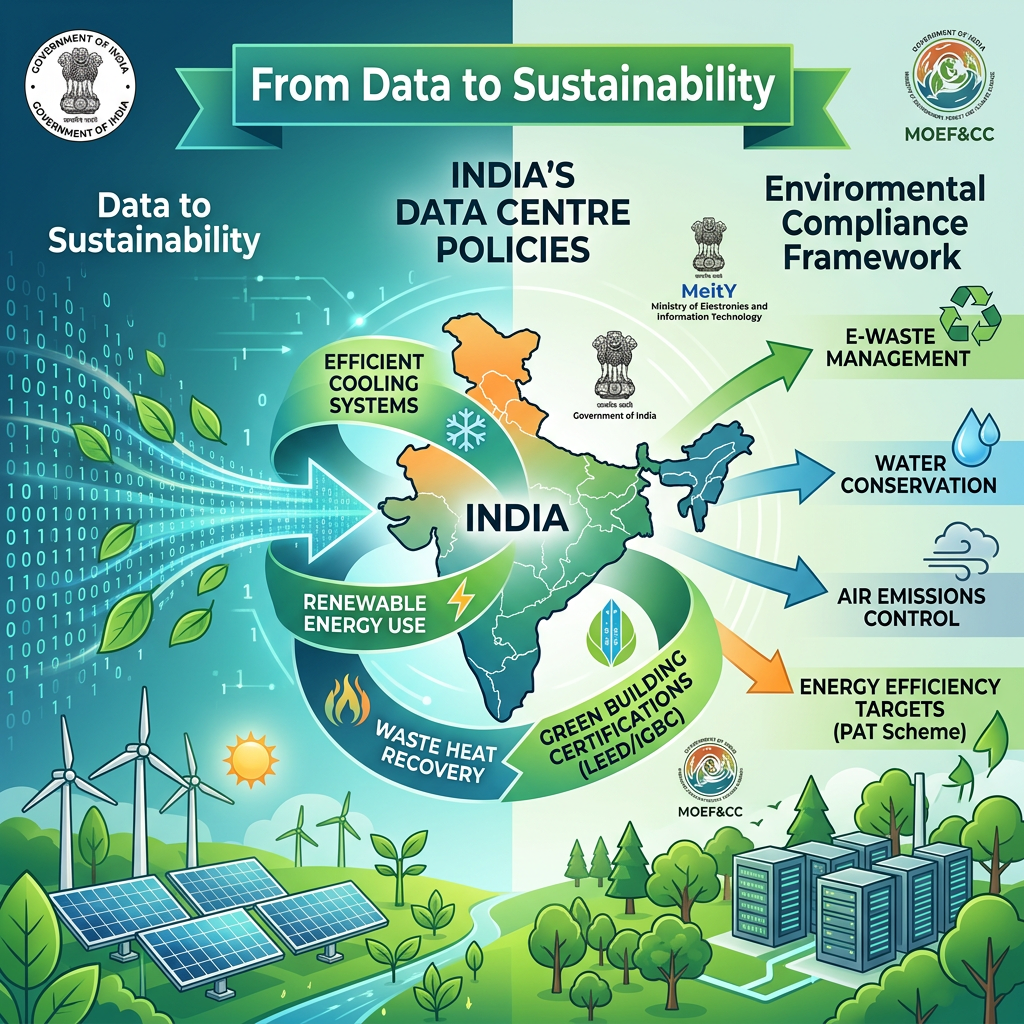
Rise of data centers in India:
A data center is a physical room, building or facility that houses IT infrastructure for building, running and delivering applications and services. A Strong data center infrastructure has become necessary due to India’s expanding digital economy, which is fueled by rising internet penetration, digital commerce, online services, digital payments, and the adoption of cutting-edge technologies like artificial intelligence and the Internet of Things. For the safe processing, management, and storage of the enormous amounts of data produced by these operations, data centers are crucial.
Further tremendous volumes of data generated by individuals, businesses, and government institutions has increased the demand for reliable, secure, and scalable data storage and processing facilities within the country. Establishing data centers domestically can enhance business continuity, boost the resilience of vital digital infrastructure, and enable low-latency digital services. It is additionally required in light of the proposed Data Protection Act’s data localization regulations and to safeguard the nation’s digital sovereignty in an increasingly interconnected world. In order to support India’s digital transformation, fulfill the growing demand for data processing and storage, and enable the nation’s emergence as a global data center hub, it is imperative that local data center infrastructure be developed.
India does not yet have a dedicated central law on data centres, however, Ministry of Electronics and Information Technology (MeitY), formulated the Draft Data Centre Policy, 2020.
Draft Data Centre Policy, 2020.
The Government of India, through the Ministry of Electronics and Information Technology (MeitY), formulated the Draft Data Centre Policy, 2020, with the objective of accelerating the growth of data centre infrastructure in the country and positioning India as a global data centre hub. The policy framework seeks to strengthen the “Atmanirbhar Bharat” initiative by identifying possible opportunities of manufacturing of Data Centre equipment (IT as well as non-IT) in the country. It also identifies possible areas of participation by MSMEs and Start-ups. The policy measures are applicable for Data Centre park developers/Data Centre operators as well as the allied ecosystem of Data Centre sector.
The broader objective is to strengthen domestic data storage and processing capabilities, promote digital sovereignty, improve ease of doing business, and position India as a preferred global destination for data centre investments.
The draft has come up with Strategies for growth of Data Centre Sector which includes:
- To enable Ease of Doing Business:Aims at creating favourable climate for both domestic and foreign investments in the Data Centre Sector. The draft seeks certain reforms for the purpose of making a robust and sustainable Data Centre sector in the country. The reforms include:
- Government of India to work towards providing “Infrastructure status” for the Data Centre sector, at par with other sectors like Railways, Roadways and Power.
- Simplify clearances for setting up Data Centres in India. The draft proposes to Institutionalize single window clearances in time bound manner for setting up data centers/ data center parks. The draft also proposes, for the data centers to operate, the list of approvals / clearances required to be published.
- Setting up of Pre-provisioned Data Centre Parks. In order to enable a play and plug model for data center providers, pre provisionalised data center parks shall be promoted. Further data centers shall have access to power availability at low rates, High capacity network back-haul, pre approved clearances and approvals.
- Formulation of Data Centre Incentivization Scheme (DCIS). Government of India which would specify the intended beneficiaries, applicability criteria and fiscal and non-fiscal incentives for the sector. Incentives shall also be provided on usage of domestic IT hardware including servers, storage, network devices, etc. and non-IT equipment such as mechanical, electrical, plumbing, cooling equipment etc.
- Enabling a favourable ecosystem for the operations of Data Centres.To address this requirement, the policy proposes measures to ensure a consistent supply of quality power, facilitate the establishment of captive power generation facilities within data centre parks, and identify mechanisms for securing long-term electricity supply at reasonable tariffs.
- Access to Power. It also envisages strengthening the open access framework to enable data centre operators to procure electricity directly from generating companies, including renewable energy producers. Further, the policy seeks to promote the adoption of renewable energy sources, such as solar and wind power, and encourage energy-efficient technologies to reduce energy consumption and the carbon footprint of data centres. For effective implementation, it proposes the constitution of a Steering Group comprising representatives of the Ministry of Power, MeitY, and State Governments to identify and coordinate mechanisms for ensuring the availability of reliable and quality power.
- Encourage joint ventures between the foreign investors and domestic companies to promote participation from Indian companies, in the development of Data Centres. This would enable long-term capacity building of the domestic companies operating in this space.
- Data Centre Facilitation Unit. The Draft Data Centre Policy, 2020, outlines an institutional governance framework featuring an Inter-Ministerial Empowered Committee (IMEC) led by the Secretary of MeitY to enhance policy implementation and business conditions. It proposes a Data Centre Facilitation Unit (DCFU) within MeitY as the main coordinating body for implementation and monitoring, along with a Data Centre Industry Council (DCIC) to represent industry interests. The policy includes provisions for independent evaluations to assess its effectiveness and suggest modifications.
State Policies.
Several States in India have introduced dedicated data centre policies or incorporated data centre incentives into their broader information technology policies to attract investment and strengthen digital infrastructure. These States include Telangana, Uttar Pradesh, Tamil Nadu, Karnataka, Maharashtra, Gujarat, Odisha, West Bengal, Haryana, Andhra Pradesh, Madhya Pradesh, Punjab, Rajasthan, Himachal Pradesh, and Chhattisgarh.
Among the notable policy initiatives, Telangana introduced its Data Centre Policy in 2016, followed by Uttar Pradesh in 2021, Tamil Nadu in 2021, Karnataka for the period 2022–2027, Odisha in 2022, and Haryana in 2022. Maharashtra has addressed data centres through its broader IT/ITeS policy framework. More recent developments include Rajasthan’s Data Centre Policy, 2025, and the data centre policies introduced by Gujarat and Uttar Pradesh in 2026.
India’s infrastructural requirement for data Centers.
Data centers rely on three critical infrastructural subsystems: IT infrastructure, power systems, and thermal management. IT infrastructure comprises servers, storage arrays, and networking equipment, while power systems ensure an uninterrupted electricity supply through transformers, backup generators, and uninterruptible power supplies (UPS). Thermal management systems, including precision cooling units and chillers, maintain optimal operating temperatures, ensuring reliability, efficiency, and resilience.
From a lifecycle perspective, the data centre value chain encompasses six key phases: planning and design, construction, installation and commissioning, operations and maintenance, upgradation and expansion, and decommissioning and end-of-life management.
Environment Compliance for establishment of Data Centers.
Environmental compliance requirements for data centres in India primarily relate to environmental clearance, pollution control, water management, groundwater extraction, and energy efficiency. Under the Environmental Impact Assessment (EIA) Notification, 2006, as amended, data centres do not require prior Environmental Clearance (EC) merely by virtue of being data centres. However, EC is required where the project falls under Item 8(a), covering building and construction projects with a built-up area exceeding 20,000 sq. m, or Item 8(b), covering township and area development projects involving an area of 50 hectares or more and/or a built-up area of 1,50,000 sq. m or more. Such clearance is granted by the State Environment Impact Assessment Authority (SEIAA).
Water consumption and wastewater discharge during the construction and operation of data centres are regulated under the Water (Prevention and Control of Pollution) Act, 1974, and applicable provisions of the Air (Prevention and Control of Pollution) Act, 1981. The concerned State Pollution Control Board (SPCB) or Pollution Control Committee (PCC) monitors compliance. Environmental appraisal may also consider freshwater availability, water balance assessments, greywater generation, and the recycling and reuse of wastewater. Groundwater extraction for infrastructure and commercial projects is regulated under the Ministry of Jal Shakti’s Notification S.O. 3289(E), dated 24 September 2020, as amended on 29 March 2023.
Accordingly, the environmental compliance obligations of a data centre must be determined on a project-specific basis, considering its scale, construction characteristics, water requirements, wastewater discharge, groundwater use, and cooling infrastructure.
India’s current position wrt Data Centers in India.
The Press Information Bureau (PIB), in its recent article outlines the growing need for data centres in India and the current status of the sector. Given below provides current status of the sector:
- The National Informatics Centre (NIC) has established National Data Centres at Delhi, Pune, Hyderabad and Bhubaneswar, along with 37 smaller data centres across various State Capitals, to support the delivery and uninterrupted operation of government digital services.
- India’s data-centre sector has witnessed significant growth, with installed power capacity increasing from approximately 375 MW in 2020 to 1.57 GW as of August 2026. Capacity is projected to reach nearly 8 GW by 2030. Investments of approximately USD 70 billion are reportedly underway, with a further USD 90 billion in announced projects, indicating substantial planned expansion in the sector.
- The Government has introduced several measures to facilitate this growth. The Union Budget 2022–23 included data centres in the Harmonised List of Infrastructure, enabling them to access applicable infrastructure-sector benefits.
- Further, the Union Budget 2026–27 introduced a tax holiday until 2047 for eligible foreign cloud service providers using data-centre infrastructure in India, subject to the prescribed conditions.
- The Government has also implemented Production Linked Incentive (PLI) Scheme 2.0 for IT Hardware to strengthen domestic manufacturing of products such as servers, attract investment, reduce import dependence and integrate India into global supply chains.
- NITI Aayog’s Frontier Tech Hub launched the Data Centre Evaluation Framework on October 14, 2026, to assist States in planning for sustainable data centre growth. This Framework focuses on transitioning from merely attracting investments to establishing investment-ready infrastructure that protects resources and maximizes long-term economic value. It is built on five pillars: Power and Energy, Water and Cooling, Siting and Environmental Sustainability, Economic and Strategic Value, and Policy, Governance, and Implementation.
Conclusion:
India’s data centre industry is expanding rapidly, supported by government policies and growing digital infrastructure requirements.
However, its sustainable development requires compliance with environmental clearance, pollution control, water conservation, and waste management regulations. Central and State policies play a crucial role in promoting investment while encouraging energy efficiency and responsible resource utilisation, therefore, a coordinated regulatory approach is essential to balance technological advancement with environmental protection.
-Sakshi Khulve, Principal Associate, Ductus Legal


