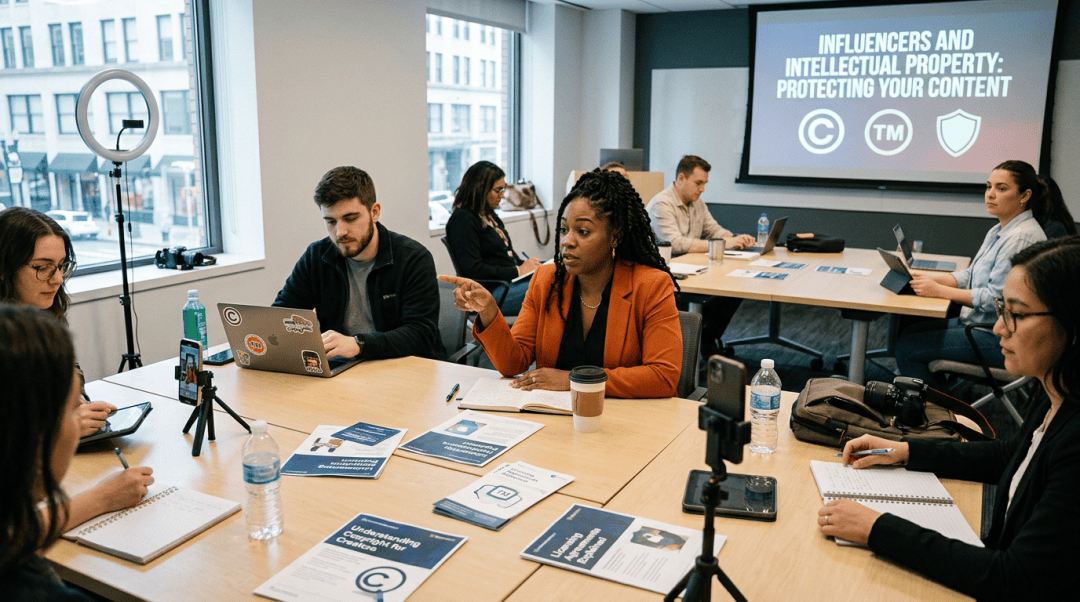
From a social media post to intellectual property
A single Instagram Reel can reach millions. A photograph can become a brand’s next advertising campaign. A product review can generate sales, and a few seconds of carefully edited footage can turn an ordinary individual into a recognised digital creator. In today’s social media economy, content is no longer just something we scroll past; it is something we create, consume, commercialise and, increasingly, fight over.
Influencers have transformed their online presence into a profession. Through brand collaborations, paid partnerships, sponsorships and advertising arrangements, they have built businesses around their creativity and digital identities. Behind every viral post may be hours of scripting, filming, editing, conceptualising and creative effort. What appears to be a thirty-second video on our screens may represent an entire creative process and a valuable commercial asset.
But here is where the legal question begins.
Imagine an influencer spends hours creating a video, carefully selecting the visuals, writing the script and editing every frame. The video goes viral. A brand notices its popularity, downloads it, removes the creator’s watermark and incorporates it into a paid advertising campaign — without seeking permission, offering credit or paying the creator.
Does uploading content on a public platform mean surrendering ownership over it? Can a brand turn someone’s creative effort into its own commercial opportunity simply because the content was available online?
The answer is no. Visibility is not ownership, virality is not permission, and a public post is not a copyright-free resource. This raises a fundamental question for the creator economy: when content becomes currency, who has the legal right to control, reproduce and commercially exploit it?
The legal ownership of an influencer’s content
The starting point is the Copyright Act, 1957. Section 13[1] recognises copyright protection in original literary, dramatic, musical and artistic works, cinematograph films and sound recordings. This means that influencer content can receive copyright protection depending upon the nature of the work and the originality involved.
An influencer’s digital content may involve several independently protectable elements:
Photographs: Original photographs and creative visual compositions.
Videos and Reels: Cinematograph films, including the audiovisual production.
Scripts and captions: Original written scripts, articles, captions and descriptions.
Music and sound: Original musical compositions and sound recordings, subject to the respective rights of composers, performers and producers.
Artwork and graphics: Original illustrations, animations, thumbnails, designs and other visual material.
Importantly, copyright protects the expression of an idea and not the idea itself. An influencer cannot claim exclusive copyright over the general idea of a skincare routine, a travel vlog or a particular social media trend. However, the original script, footage, editing, graphics and other creative expressions used to present that idea may be protected.
The Face in the Frame vs. The Owner Behind the Lens- who owns the post
Here is an interesting legal paradox in the influencer economy: the person whose face appears in a photograph or video is not necessarily the person who owns the copyright in it. An influencer may be the face of a campaign, the voice behind a product review or the central figure in a viral Reel, yet the copyright may belong to someone else.
Under Section 17[2] of the Copyright Act, 1957, the general rule is that the author of a work is its first owner, subject to certain statutory exceptions. In simple terms, appearing in a photograph does not automatically make an individual its copyright owner.
For instance, when an influencer independently conceptualises, scripts, records and edits a Reel, they may own copyright in the original creative elements they contribute. However, if a professional photographer is engaged to capture the influencer’s photographs, the photographer will ordinarily be considered the author and first owner, subject to the applicable contractual arrangements and statutory exceptions.
The distinction becomes even more complicated when brands enter the picture–
Consider a fashion brand that hires an influencer for a promotional campaign. The influencer appears in the photographs, a photographer captures the images, and a production agency undertakes the editing and post-production. The brand finances the entire campaign.
Now comes the million-dollar question: who owns the photographs and the resulting promotional content – the influencer, the photographer, the production agency or the brand?
The answer is not necessarily the person who paid for the campaign or the person whose face appears in it. Section 17(b)[3] of the Copyright Act provides a specific exception for photographs, paintings, portraits, engravings and cinematograph films made for valuable consideration at the instance of another person. Unless there is an agreement to the contrary, the person at whose instance the work is made may be its first copyright owner.
This makes contractual arrangements particularly important in influencer collaborations. Before agreeing to a campaign, an influencer should understand whether they are:
- Retaining ownership: Keeping copyright in the original content they independently create.
- Acquiring ownership: Obtaining copyright through a valid assignment from the existing owner.
- Obtaining permission: Receiving a licence to use photographs, videos or other material owned by a photographer or production agency.
- Granting commercial rights: Permitting a brand to use their content for specified purposes without necessarily transferring copyright ownership.
The distinction between an assignment and a licence is particularly important. An assignment under Sections 18[4] and 19[5] transfers copyright ownership, wholly or partially, subject to the statutory requirements. A licence under Section 30[6], on the other hand, permits another person to exercise specified copyright rights without necessarily transferring ownership.
In the influencer economy, a brand collaboration should never be reduced to a simple exchange of money for a post. The real question is: what rights are being transferred, to whom, and for how long? A brand’s permission to repost an influencer’s Reel, for instance, should not automatically be treated as permission to convert that same Reel into a nationwide advertising campaign.
The hidden copyright problem behind reposting and sharing
Social media has normalised the practice of reposting, sharing, downloading and recreating content. A popular Reel can be circulated across Instagram, Facebook, YouTube and other platforms, sometimes without the original creator receiving any recognition.
But does tagging the original creator make such use lawful? Not necessarily.
Attribution and authorisation are two different things. Giving credit to an influencer does not, by itself, establish permission to reproduce or commercially exploit their copyrighted work.
Section 14[7] of the Copyright Act provides the copyright owner with exclusive rights, including rights relating to reproduction, communication to the public and adaptation, depending on the category of work. Section 51[8] addresses infringement where protected rights are exercised without the requisite licence or authority.
Consider three situations:
- An individual shares an influencer’s Reel using the platform’s native sharing feature.
- A competing creator downloads the influencer’s video and uploads it as their own.
- A company downloads the influencer’s video and incorporates it into a paid advertisement.
These situations should not automatically be treated alike. The first may be an ordinary platform-enabled sharing activity. The second may amount to unauthorised reproduction or communication. The third raises additional commercial exploitation and licensing concerns.
The fact that an influencer has enabled public viewing of their content does not mean that every third party has acquired an unrestricted right to reproduce, modify or commercially exploit it.
Brand collaborations: Who controls the content after publication?
A brand collaboration may look like a simple business arrangement: the influencer creates the content, the brand pays for it, and the post goes live. But behind every sponsored Reel or promotional photograph lies a more important legal question: does paying an influencer for content also give the brand ownership over it? Not necessarily.
In the influencer economy, commercial agreements determine how far a brand can go in using, reproducing and exploiting the content created for a campaign. While a brand may engage an influencer to produce a video, review a product or participate in an advertising campaign, the payment received does not automatically resolve the question of copyright ownership or the extent of the brand’s usage rights.
This is where the fine print matters. A well-drafted brand collaboration agreement should clearly establish:
- Ownership: Does the influencer retain copyright, or is ownership being assigned to the brand?
- Nature of the licence: Is the brand receiving an exclusive or non-exclusive licence?
- Permitted platforms: Can the content be used only on Instagram, or also on YouTube, websites and other advertising platforms?
- Modification rights: Can the brand edit, crop, adapt or repurpose the original content?
- Duration and territory: How long can the brand use the content, and in which geographical markets?
- Commercial exploitation: Does the agreement permit the brand to use the content in paid advertisements and promotional campaigns?
- Post-collaboration use: Can the brand continue using the content after the contractual relationship ends?
- Sublicensing: Can the brand authorise advertising agencies, marketing partners or other third parties to use the content?
Consider this: an influencer agrees to let a fashion brand repost a promotional Reel on its official Instagram account. A few months later, the same brand uses that Reel in a paid advertising campaign, incorporates it into its website and displays it on outdoor billboards.
Can the brand justify all these uses merely because it had permission to repost the original Reel?
The answer depends on the terms and scope of the licence granted. Permission for one particular use should not automatically be interpreted as unrestricted permission for every form of commercial exploitation.
Influencers must also be cautious of broadly worded contractual clauses that transfer rights over all existing and future content without clearly identifying the works, rights, duration, territory and intended uses. After all, a brand may pay for a post, but does it get to own the creator’s work forever? That is a question which should be answered in the agreement, not after the content has gone viral.
What happens when an influencer’s work is copied?
Copyright protection would have little practical value if creators had no remedies against unauthorised exploitation.
Section 55[9] of the Copyright Act provides civil remedies for infringement, including injunctions, damages and accounts of profits, subject to the statutory requirements.
An influencer whose work has been copied may consider:
- Preserving evidence of the original creation and publication, including raw footage, drafts, timestamps and project files.
- Identifying the unauthorised use and recording the relevant URLs and screenshots.
- Sending a cease-and-desist notice seeking removal or cessation of the unauthorised use.
- Using the platform’s applicable intellectual-property reporting mechanism.
- Seeking appropriate civil remedies where infringement continues.
Copyright registration is not a prerequisite to the existence of copyright in India. Protection generally arises automatically when an original work is created. Nevertheless, registration can provide useful evidentiary support in ownership disputes.
The changing role of platforms and the creator’s responsibility
Every time an influencer uploads a photograph, Reel or video, it enters an ecosystem controlled by social media platforms. These platforms provide the tools to publish, share, distribute and monetise content, but they also operate under terms and conditions that creators often accept without examining closely.
This raises an important question: when an influencer clicks ‘Upload’, are they simply publishing their content, or are they also granting the platform certain rights over it?
Most social media platforms contain provisions in their terms of service under which users grant the platform a licence to host, display, distribute or otherwise use uploaded content for specified purposes. However, granting such a licence should not automatically be confused with transferring copyright ownership. The extent of the platform’s rights depends on the actual terms governing that service.
But the responsibility does not end with understanding platform policies.
An influencer may independently create an original video, but that does not give them unrestricted freedom to incorporate another person’s photograph, copyrighted music, film footage or artwork into it. Each of these elements may carry separate copyright protection and may require appropriate authorisation.
For instance, adding a personal voiceover to someone else’s video, inserting copyrighted music into a product review or placing a watermark on downloaded artwork does not automatically make the resulting content original or free from infringement.
In the creator economy, originality is not established by the number of edits made, the addition of a watermark or the act of uploading first. It lies in the actual creative contribution and the rights that the creator is legally entitled to exercise.
Conclusion: A creator’s post is more than a post
The influencer economy has changed the commercial value of everyday digital expression. A short video, a photograph or an original caption can become a source of revenue, brand recognition and professional opportunity.
However, the ability to publish content online should not be confused with the ability to protect it.
Indian copyright law provides a framework through which creators can assert ownership, control reproduction and regulate commercial exploitation. Yet, the effectiveness of that protection depends significantly on understanding authorship, contractual arrangements, third-party rights and licensing conditions.
Ultimately, the question is not merely who uploaded the content first, but who created the protected expression, who owns the relevant rights and who has been authorised to exploit them.
In an economy where content is currency, copyright is one of the most important tools through which creators can protect the value of their work.
[1] https://ipindia.gov.in/pages/copyright/chapter
[2] https://ipindia.gov.in/pages/copyright/chapter
[3] https://ipindia.gov.in/pages/copyright/chapter
[4] https://ipindia.gov.in/pages/copyright/chapter
[5] https://ipindia.gov.in/pages/copyright/chapter
[6] https://ipindia.gov.in/pages/copyright/chapter
[7] https://ipindia.gov.in/pages/copyright/chapter
[8] https://ipindia.gov.in/pages/copyright/chapter
[9] https://ipindia.gov.in/pages/copyright/chapter
-Anwesha, Associate, Ductus Legal


